Knowledge work as we know it is dying
That sounds dramatic. Increasingly, I don’t think it is.
Software writes software. AI generates reports, presentations, analyses, documentation, and prototypes at a speed that would have seemed absurd only a few years ago.
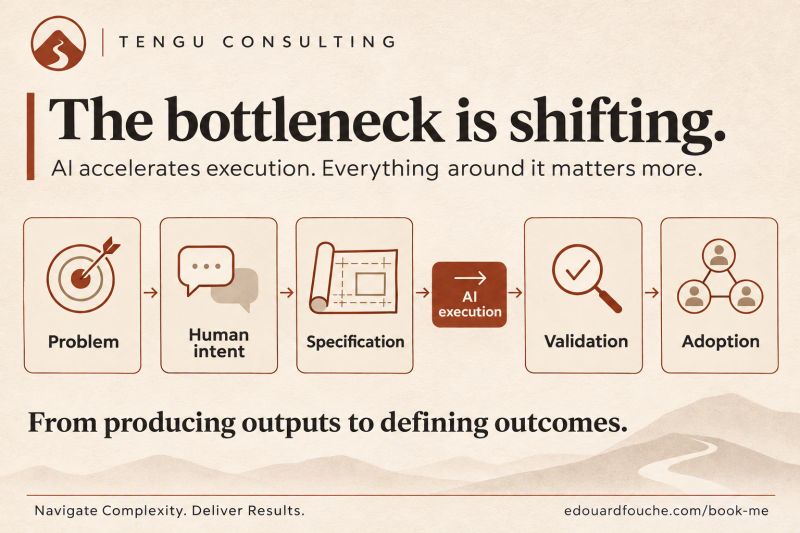
As a result, the scarce skill is shifting.
It is becoming less about producing the thing and more about figuring out what the right thing to build actually is.
Then comes something surprisingly difficult: extracting the real requirements from humans, including the ones they struggle to articulate themselves, and translating them into specifications precise enough for AI to execute.
And once the technology works, new challenges begin:
- Getting it through the processes, governance, and organizational complexity of a large corporation without losing speed.
- Getting people to trust it.
- Getting people to actually change how they work.
So perhaps the emerging knowledge-work stack looks something like this:
Problem → Human intent → Specification → AI execution → Validation → Adoption
AI is collapsing the cost and time of the execution step, thus everything around it suddenly matters much more.
This is why I find the current moment both incredible and disturbing.
P.S. The new Stanford AI100 report reaches a similar conclusion at a much broader societal scale: AI is transforming science, software, cybersecurity, media, geopolitics, and even warfare faster than our institutions and governance are adapting.